


The artificial intelligence landscape continues to evolve by leaps and bounds, and one of the most recent protagonists in this field is Kimi K1.5, developed by the Chinese company Moonshot AI. This multimodal artificial intelligence model is designed to outperform other benchmark models, such as OpenAI-o1, across a variety of complex tasks. Below, we will explore the features, capabilities, performance, and future of Kimi K1.5, as well as its impact on the AI landscape.
Recently launched at the end of January 2025, Kimi K1.5 presents itself as an AI model capable of processing diverse inputs, including text, images, and code. This model not only stands out in current benchmarks but also positions itself as a viable option for solving complex problems efficiently. The versatility of Kimi K1.5 marks an important breakthrough in how AI interacts with multimodal data.
One of the most innovative aspects of Kimi K1.5 is its use of advanced reinforcement learning (RL) techniques, which considerably enhance its reasoning capacity and adaptation to different types of tasks. Below, we detail the key ingredients that make this model a benchmark in the sector:
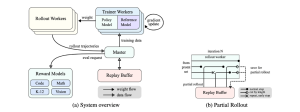
Long-Context Scaling: Kimi K1.5 extends the context window for reinforcement learning up to 128k tokens, significantly improving its performance on long-range tasks. A partial rollout method is employed to boost training efficiency, allowing large fragments of previous trajectories to be reused without needing to regenerate them from scratch. This demonstrates that context length is a key factor in scaling RL with language models.
Policy Optimization: An improved formulation of reinforcement learning with extended chains of thought (long-CoT) is introduced, along with a variant of the online mirror descent algorithm to robustly optimize the model’s decision policies. Additionally, more effective sampling strategies, length penalties, and data recipe improvements have been integrated to increase precision and stability.
Simplified Learning Framework: Thanks to the combination of long-context scaling and policy optimization, a simpler yet highly efficient reinforcement learning framework for language models is established. This approach allows the model to develop planning, reflection, and correction properties, eliminating the need for more complex techniques like Monte Carlo tree search, value functions, or reward models.
Multimodal Capabilities: Kimi K1.5 has been jointly trained on text and vision data, allowing it to reason in an integrated manner across both modalities. This capability represents a significant advancement in how artificial intelligences can interact with the world, enabling more versatile and contextualized problem-solving.
The ability of Kimi K1.5 to outperform other models, including DeepSeek-R1, has been evidenced through comparisons in key benchmarks. Kimi K1.5 has achieved industry-wide state-of-the-art standards, excelling in reasoning and information processing tasks. These comparisons demonstrate that the model is not only competent but a leader in its category.
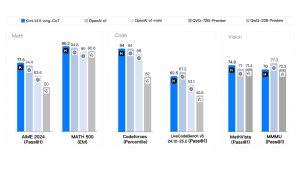
Source: Kimi K1.5: Scaling Reinforcement Learning with LLMs (Technical Report)
Kimi K1.5 has been designed with accessibility in mind. Now available on a web platform, this model enables real-time search and file analysis, making it easy for users across various industries to interact with the model in a practical way. These capabilities are intended to democratize access to advanced AI technologies, allowing a wider audience to benefit from its capabilities.
Moonshot AI has open-sourced Kimi K1.5, allowing the research community to contribute to and improve the model. This approach not only highlights the company’s commitment to transparency but also fosters innovation within the sector. With the goal of leading the AI market in China and competing with giants like OpenAI, Kimi K1.5 establishes itself as an industry benchmark.
Kimi K1.5 represents a significant step forward in the field of multimodal artificial intelligence. Thanks to its long-context scaling, policy optimization, and simplified learning framework, this model demonstrates superior capabilities in information processing and reasoning. Furthermore, its enhanced accessibility and focus on multimodality position it as a key tool across various sectors.
The research and development opportunities are vast, suggesting that the future of Kimi K1.5, and artificial intelligence in general, is promising. As the research community gets involved, new applications and improvements are likely to emerge, making Kimi K1.5 an even more powerful tool for solving complex problems in an increasingly multimodal environment.
📥 Download my practical guide to integrating AI into your company!